
Art Pepper: Tastes from the Widow's kitchen
Sunday, May 14, 2017
ALMOST-FREEBIE FOR MAY!
Recorded (badly!) in Adelaide, Australia with the Last Quartet. George Cables, David Williams, Carl Burnett. Pictured is Peter Noble who produced this GREAT and delightful tour in August, 1981.
There's a new album coming
In November of this year.
It's a dilly, it's a big one
Pivotal in Art's career.
I'll say no more about it, but as many of you know
I try to be a good guy and to keep my prices LOW.
If you want to help to keep me on this straight and narrow path
All you fans will gather round now, and help me with the math.
Keep the music coming, donate to it and me.
And a happy May to all of us!
Signed, LP
P.S. If you can't manage more than a buck, that's fine. I'm sorry I'm charging even that. But 1. This is a beautiful long track (albeit audio-wise it sucks). And 2. (believe it or not!) literally thousands of people download the freebies and never ever give any money for them. You can say, "Well, you ARE promotiing them for free!" Which is true. But come on, thousands of people and not a dime! (Are they bots?)


Tuesday, April 4, 2017
HOW I REALLY FEEL

In a short time, Omnivore will be releasing a remastered version of the album pictured above. The Art Pepper Quartet. I always think of it by its original catalogue number, Tampa 20. I'm licensing it to Omnivore partly because they have a bigger (and younger) audience than I do, with my label, Widow's Taste, and I feel it's time let them hear what great jazz, great music sounds like. The Omnivore release will be on vinyl and later on CD. I was asked to write a liner for the CD, and writing about this album opened the floodgates. So I'm printing the note, in advance, here, certain that most of Omnivore's customers (who'll buy the vinyl) will never see it. And I want it seen.
The Art Pepper Quartet
I
have to say it. Categorically. This album, recorded in November, 1956, is my
favorite Art Pepper album.
Some
people insist that the “old” Art Pepper of the 1950s, lyrical, elegant,
ingenious, is the best. Others prefer the later, funkier, wilder,
heartbroken-and-desperately passionate fellow I fell in love with. I adore him
in all his permutations. But this album’s different: I could listen to this
particular recording every day for the rest of my life. I love it. And not just
because I own the master, though that’s part of it. The story of the the making
and “rescuing” of The Art Pepper Quartet album is a glimpse into Art’s life,
my life, and the jazz record business as it used to be.…
When
Art died in June of 1982, I was so deep in grief. Condolence letters came in
every day for months, and every day I sat and read them to Art’s picture,
weeping. And I was broke. My own fault.
I’d been handling the money—and, when Art’s career bloomed so beautifully
during his last years, touring and recording, the money was so good.
More than either of us ever had before, so naturally we spent it all. Art on
cocaine, and me—band manager, secretary, travel agent, 24/7 nursemaid—on
clothes and jewelry and restaurants. Because that was only fair!
So
when Art died, I couldn’t pay the rent.
I’m exaggerating. I got a refund for the plane tickets I’d purchased for an
upcoming tour, and that money kept me solvent until I got a few temp jobs
typing and editing. My rent was low. And I still had parents.
And
my M.O. (I know this, now) is to go into action, any action all, wrong-headed
or ingenious, when frightened, frustrated or unhappy. According to a diary I kept in ’83, I became
obsessively persistent going after unpaid royalties. When Art was dying, he
said, “At least I’ve left you well provided for.” I was out to prove him right.
One
thing I did was research every album Art had done for which no royalties were
paid, and one of those was “Tampa 20.” That was the original Tampa Records
catalogue number of The Art Pepper Quartet. It was being marketed here and
abroad in record stores—by bootleggers, as you’d suspect, but also by people
who seemed, legitimately, to own it. I tracked them down, demanding that they
prove they really owned it, royalty free. I asked to see a contract.
Bob
Scherman, producer and original owner of the Tampa label, was still among the
living. He had a house out in the Valley, not far from my collapsing cottage in
Van Nuys. Scherman refused to talk to me. Then I learned that he was suing Alco
Engineering and Entertainment who was likewise claiming ownership. They
wouldn’t talk to me either.
But then Alco filed for
bankruptcy—coincidentally in time for me to make a move—in 1983. I spent the
early part of of the year trying locate
the court-assigned bankruptcy attorney, Arnold Kupetz. He wouldn’t talk to me
because, as I was learning, lawyers only talk to other lawyers. So I got a
friend of mine, a lawyer, to write to Kupetz for me. When he didn’t even answer
him, I called the office up repeatedly, once or twice a day, and I must
have finally gotten through: In my diary I wrote, “He’s very rude.” He claimed
he didn’t get my lawyer’s letter, so I read it to him on the phone and sent it
once again and this time Certified.
By
the end of the year, I’d bargained Kupetz down from $5000 to $1000 for Tampa
20, thinking I was slick. I scraped the cash together, paid, and in January,
1984, I brought Art’s old producer, Ed Michel, along to wander through the dark
and damp and drafty tin-roofed Alco warehouse in downtown L.A. I needed Ed to
help me find masters, “mothers” and every scrap of tape relating to my
album—specific items Ed would recognize; I wouldn’t. A few weeks later, a small
label, V.S.O.P. Records, bought the rest of the Tampa catalogue—of more than 40
west coast artists—for $1,500. Surprised to find one album missing, the new
owner tracked me down, asking if I’d sell my single hold-out. Hell would freeze
over first, I said. (I had told Kupetz if he put me in a bidding war, I’d sue
the court for my back royalties and hold up everything.) V.S.O.P.’s Peter Jacobson and I eventually
became good friends. And even though he got the better deal, financially (He’s
another lawyer. He’s the one that’s slick.), I got the single session we both
thought most worth having. This one.
What’s the appeal of this one?
It’s the physical embodiment of a
precious moment, miraculously captured, when everything was perfect, all the
circumstances—the band and music, the recording situation, but most
importantly, Art’s mental state. In my life with him, I think I’ve heard the
music of Art’s every mood, but never this one where he so simply soars, he
sings. He is, in that moment, so uncharacteristically uncomplicated and so
confident, more confident than he would ever be again.
He had reason to be. He was playing
everywhere in 1956, was playing all the time. When I look at his discography,
online, I see that he was in one recording studio or another every single week,
sometimes more than once a day. The rest of the time he was performing in
clubs. Combine that constant practice with his phenomenal gifts (and with this
familiar band, especially Russ Freeman on piano) and beauty came so easy.
And it’s such a hopeful album. It
just feels young. Recently freed from Terminal Island Federal Penitentiary and
barely 31 years old in 1956, Art still believed he had a future. And he was in
love. He’d just married his second wife, Diane—for whom he wrote the stunning
ballad here. He recorded other albums during this short span, but those were
more demanding, had more sidemen, more arrangements. This one must have felt so
effortless. At least that’s how it sounds.
Twenty years later, near the end of
his life, Art took more risks when he performed—rhythmically, harmonically,
emotionally. Ed Michel has said that what gave Art’s later work its power was a
feeling of “shared danger.” By then Art’s youthful confidence had been
burned away by what his life became—an immolation in a world of drug addiction
and incarcerations, and he came to know he had no future—just this
crucial moment at the microphone. And,
when he performed, he beguiled his audience, as he talked or played to them,
into his overwhelming state of overwrought adrenaline, made us share his
terror, glee, and the incendiary desperation in his derring-do. His intensity
consumes us, makes us blaze along beside him.
Well, sometimes we don’t want to set
the world on fire. Sometimes we want to lie on the grass, look up into the
trees, and watch the branches dip and lift and wave their leaves against a
sunny sky. Which brings us back to 1956 and “Tampa 20”, and…
The Band
In jazz
circles Russ Freeman,
the pianist at this session, is best known for his collaborations with
Chet Baker. An obituary in The Guardian, 2002, praises that relationship, “it was Freeman who picked and arranged the
tunes, and explained the harmonies to the trumpeter, who could not read chords,
on their living-room piano. Baker's characteristic style - embroidering the
melodies with delicate alternative lines - emerged in these sessions, and
Freeman, providing a sinewy alternative to Baker's vaporous style, contributed
an invaluable contrast.” —John Fordham
I like that word,
“sinewy.”
Art (never the least
bit “vaporous”) had been playing with Russ since 1949 and admired him
tremendously. Russ had the same kind of respect Art had for a beautiful tune.
Listen to the two of them on I Surrender Dear. For people who hate
or don’t understand “jazz” (sometimes I’m one of
them) this could be Lesson #1 on how to improvise, respectfully, on a terrific
song, coaxing all the loveliness, sense, and swing out of a tune without
altering its essence. What they did exemplifies “cool” in the best sense of the
word. In fact, “Tampa 20” could be exhibit ‘A’ for what was known as “West
Coast Jazz”. A composer and arranger, Russ also wrote some songs: best known—The Wind, recorded by Mariah
Carey, among others. Russ went on to write film scores and produce TV
commercials. I got to meet him once, and what a thrill to tell him that I loved
him. What a nice man, kind and funny. He was 76 years old when he died in Las
Vegas in 2002.
Bassist, Ben Tucker,
also wrote some songs, and one of them, I’m
Comin’
Home,
charted for Mel Tormé in
1962 and has been covered by a lot of people, including The Spencer Davis
Group(!) and Michael Bublé. Tucker had a long, illustrious
career playing with almost every jazzman on the coast. Eventually he moved to
Georgia where he bought some radio stations, and he continued playing music
until he died at 82, in 2013. In a golf cart accident.
By
November, 1956, he had already joined Art on 3 other albums along with drummer,
Gary Frommer.
Art held his sidemen to high standards, and
Gary met those standards. He was another West Coast guy, whom Art may have met,
originally, in 1950, in Shorty Rogers’s “Giants” band. An online comment by
someone who’d employed Gary later on described him as “kind of a walking
disaster.” I met Gary, too. He was one of those good-looking charmers who (a
girl can tell) promises to be a lot of trouble. He worked with Charlie Parker,
and, during the ‘60s, with Henry Mancini, so he was a pro, and Art liked him,
featuring him in his quartet with Hampton Hawes at the Surf Club in those days.
Frommer died in Anchorage, in 2005, age 70, where, an obituary tells me, he was
an active church member and a volunteer at his local library.
The
Tunes:
The
preference in the fifties seemed to be for shorter songs. Maybe the record
companies worried their customers would feel cheated if they didn’t get enough
tunes on an album? Maybe they were hoping to get airplay? All the songs on
Tampa 20 are very short, and that’s too bad. I’m sure these guys stretched out
when they played the tunes in clubs. Well, good things, small packages, let’s start
with Art’s
Opus, since what’s true of that is true of every sweet track on
the album:
It
starts off casual, like a careless, friendly conversation: Art says: “Okay,
like, here we are, here’s a song I wrote on the changes to I Got
Rhythm, and we’re just going to play it for a little while.” And
like Rhythm and like other standards, it has a basic
structure: chorus, chorus, bridge, and final chorus. They play Art’s brand-new
melody, and then they improvise. Art’s improvising’s so melodic as he crafts another
lively little tune, a variation on the one he started with—which is a variation
on I Got Rhythm. And, in his solo, Freeman
does the same; he “writes” a flowing melody, and then Art & Russ play
alternating “fours,”
trading ideas, musically. Well, musically, I don’t know, it may be as complex
as nuclear physics, but to me, to most of us who aren’t musicians, it’s just a
lively, clever, and affectionate little tete a tete
between a couple of good friends. Art and Gary Frommer have a little chat as
well, before Art plays his melody again and takes it home.
I’ve
mentioned I Surrender Dear. I
love Russ Freeman’s so-delicious comping behind Art on this tune. That, and all
his playing, reminds me of my first favorite piano player, Teddy Wilson, whom I
heard on my mom’s Billie Holiday records. He was another melodist. They’re both
angelic.
Then
comes beautiful Diane. Art
wrote terrific tunes. He wrote great ballads, and he wrote two of his best
during that happy year: Patricia for his daughter, and Diane for his new wife, the woman who was
supposed to “save” him and instead became a junkie, informing on him and
sending him back to prison. Diane’s sad story doesn’t doesn’t tarnish, even a
little bit, the jewel that is this love song: Art’s imagination immortalized
her in a melody and gave the world some beauty for his pains. I love this tune
so much. But it’s too short! I wish Russ Freeman had a solo on it.
All
the songs but I Surrender and Besame are Art’s originals. Pepperpot is
another little confab. with his band, an unserious delight, a darling romp.
Art’s solo dances through the changes just like Fred Astaire.
Besame Mucho is my favorite tune on
this, my favorite album. Years ago, when I played it for my artistic aunt, she
called it “swoony.”
Roughly translated, the title means “Kiss
Me a Lot.” My aunt referred to it as “Kiss Me Too Much.” Because it’s
saturated with romance. First, there’s that melody just made for dancing in the
moonlight. But then it has the delicate but unrelenting funky Latin beat. So,
it’s not just moonbeams, is it? It’s lust, as
well. Held perfectly in check (which only makes it better). Russ and Art and
Gary keep a tasteful, teasing balance between sophistication and salaciousness:
Gardenias, cigarettes, martinis on the balcony, swaying bodies, satin sliding
over, clinging to, a woman’s perfumed skin. And hot kisses ’til the end of
time.
Blues at Twilight. I
love the blues, slow blues, of every kind:
poignant the way Billie sings them; raucous and lowdown, like Howlin’ Wolf.
This one is classy. Those who know his music know Art owned the
blues, and, in time, his blues, how he expressed his
life, got steadily more deeply tragic, as he screamed them, moaned them,
whispered them into his horn. But just because he wasn’t totally miserable in 1956
when he played this one, doesn’t mean that he, like all the rest of us, didn’t
have a broken heart. You can hear him talk about it here. And listen to Russ
Freeman’s solo. It just knocks me out. Nothing fancy. No weird chords or
showing off. Simplicity, melody, truth.
Val’s
Pal, another Art original, seems to have had some problems.
There were a lot of uncompleted takes, indicating that Art wasn’t
satisfied—until he finally was. I wish there was more studio chat recorded on
the session tape. I want to know what happened. I like backstories.
Beginning
in 1951, Val Valentin was an extremely popular engineer and producer in the
record and the movie biz, and Art must have liked him to present him with a
song. It’s just a little riff, probably never even written out. Art often
improvised these “compositions” in
the moment, on blues changes, and stuck somebody’s name on them when titles
were required. During my time with him, I recall a bunch of other tunes like
this one, original blues riffs Art awarded to the folks he genuinely liked
and/or wished to cultivate and flatter. But maybe this one was really written
for Val’s actual pal.
One of those guys somebody knows who shows up at the studio with alcohol or
drugs and doesn’t give his name.
Art
died, earlier than any of his sidemen on this album, in 1982, when he was 56.
But not before he’d had another full career in music—which he packed into the
seven years before he died. Jailed repeatedly for drugs, and physically
debilitated by his drinking, he cleaned up enough to return to live performing,
touring and recording, while those other guys, were wise enough to watch their
diets and play golf. But the short, reckless life Art had was the only one he
ever could imagine living. And, at the end, he felt his hard times paid
artistic dividends. He thought without them his work might lack essential
depth, or beauty, or emotion; so he kept re-opening his wounds, himself,
exploited all his pain and shared it with his listeners. I used to have
opinions about that kind of attitude. Now I think it probably depends on who
you are, and I think it worked for him, for the mature Art Pepper: He had the
in-born genius and had honed his skills. He had an iron constitution. He had
people who looked after him. He lived long enough to make it work.
Maybe
I’m just telling you a story to justify how much I love this album,
extrapolating from ambitious, optimistic things Art said to Downbeat Magazine
in1956. From what he said to me when
we wrote Straight Life. He told me that in 1956 he
“had the world by the tail.” Well, Tampa 20 seems to be good evidence of
that—of Art’s pretty, graceful, hopeful moment before his next incarceration
(coming soon, in
early 1958). His youth, his dreams, his confidence, have been preserved
forever—on magnetic tape, on rusty metal mothers, ragged masters, and now
contained, somehow, in digits: On The Art Pepper Quartet, Art
is glowing with charisma, sweetness, promise, and élan, as he dances through this heavenly music,
just like Fred Astaire.
Laurie Pepper
January,
2017
Tuesday, February 28, 2017
INVINCIBLE
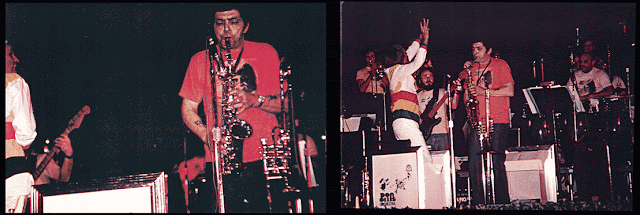 |
| Art Pepper with Don Ellis at the Whiskey a Go Go |
Hi, everybody!
Did you miss me?
Finally, and worth waiting for....
the first post of 2017
Art Pepper
with Don Ellis
AT THE WHISKEY
This is basically a soulful, pretty, powerful nine minute Art Pepper solo
with a stupendous band
The audio gets better after the first minute or two
I'm charging 3 dollars for the download
Because it's nearly ten minutes long
and
Because it's so stunning
But you can stream it for FREE (and even steal it as you stream it
if you're
1. Clever enough to do that (Congrats!)
AND 2. Broke (Sorry! Be my guest)
OR 3. If you can afford to pay but have no conscience & like to steal music (Shame on you.)
also check out....
New Release from Widow's Taste (Art and Warne Marsh): https://www.cdbaby.com/cd/artpepper26
New Releases from Omnivore: (Art and Pete Jolly, Art and Sonny Stitt
http://omnivorerecordings.com/artist/art-pepper/
Wednesday, November 16, 2016
7 MINUTE FREEBIE FROM ART & WARNE
Here is a whole half of a tune (almost 7 minutes!) included in the 3 Disc set, UNRELEASED ART: VOLUME 9 - Art Pepper & Warne Marsh at Donte's, April 26, 1974!
BUY THE ALBUM AT:
Or YOU CAN SKIP ALL THIS AND DOWNLOAD THE FREEBIE (BOTTOM OF THE PAGE). (and you can donate if you wish. This was an expensive album to produce.)
From the liner note: Donna Lee is one of my favorite bebop tunes in the world. It's got this oddly oblique melody that enchants me-and it's my favorite track on this album. And because we're at a jam session, we excuse occasional confusions and mistakes. Donna Lee is supposed to stop on a dime.John Heard forgets and plays another note, then cleans that up, and everybody laughs.
A number of people remark on Warne's "cerebral" approach, but what I hear from Warne on this track is rock-solid: it's swinging, and exceptionally cheery. And then, along comes Art. Bringing excitement. This is what jazz can be, ought to always be: Exhilaration rules! Underneath the audience applause, you hear Art's satisfaction; "Yeah," he tells the band.


Photos above from booklet: Art's life, Warne's life in 1974
AND HERE 'TISWell, it's ALMOST
7 minutes.
Wednesday, July 6, 2016
JULY FREEBIE! HIGH JINGO, ART PEPPER, LEE KONITZ....

Sunday, July 3, 2016
Happy 4th of July in the land of the FREEBIE!!!!
I'm putting together some tracks for a radio interview. I was asked to record a reading from "ART" as well. So I've uploaded the tracks AND the reading. THE READING IS FREE. If you're a fan, you already own the other tracks. They're some of my favorites. All will stream for your delight, free of charge.
The Photo below is of me listening to Art at Pasquales, a great jazz club by the sea back in the day.


Thursday, June 2, 2016
FREE: Appetizer: Art Pepper & Warne Marsh at Donte's in 1974
just the tiniest taste. I'll post more of these appetizers, until release...
The Good News: Found 4 more tracks recorded at this date, which means we have a total of fourteen tracks (14!) of Art Pepper and Warne Marsh live at Donte's. The Bad News: This find, and the necessity of remastering EVERYTHING, adds cost, and time. So, the release date has been changed from September to November 11, 2016. I'll continue to post these fragments. All will be free. Today 'Round Midnight.
The Good News: Found 4 more tracks recorded at this date, which means we have a total of fourteen tracks (14!) of Art Pepper and Warne Marsh live at Donte's. The Bad News: This find, and the necessity of remastering EVERYTHING, adds cost, and time. So, the release date has been changed from September to November 11, 2016. I'll continue to post these fragments. All will be free. Today 'Round Midnight.
Friday, May 13, 2016
It's the Merry Month of the May FREEBIE plus Excellent Offer
Diane is one of 32 professionally recorded tracks for John Snyder's Artists House label. It was recorded in New York in February of 1979 with Art Pepper, Hank Jones, Ron Carter, Al Foster. Also included in this complete set are all the tracks recorded in Los Angeles in May, 1979 with George Cables, Charlie Haden, and Billy Higgins. Diane is FREE. But if you pay for the whole set, you'll also get a downloadable, beauteous, gossip-filled, photo-filled liner note. P.S. Art plays both alto sax and clarinet, and there are five solo tracks (27 through 32), recorded in New York and never released anywhere, ever.
To get just the freebie, click HERE and select buy. Enter zero (or more) in the payment box.
To check out the whole thing (there are several streamable selections) click HERE
Most of these tracks were eventually released by Fantasy/Galaxy Records on the Art Pepper (16 CDs) Complete Galaxy Box. Which is only available on iTunes. Without, I might add, photos or liner note of any kind.
Many have been released on top quality vinyl by Acoustic Sounds.
Tracks which are included in the Galaxy box but otherwise only released in Japan are shown with one asterisk *. Tracks included in the Galaxy Box but never anywhere else are shown with two asterisks **. Most of the solo tracks have never been released anywhere ever. They're marked with two asterisks **
Here are the tracks in the COMPLETE collection.

To get just the freebie, click HERE and select buy. Enter zero (or more) in the payment box.
To check out the whole thing (there are several streamable selections) click HERE
Most of these tracks were eventually released by Fantasy/Galaxy Records on the Art Pepper (16 CDs) Complete Galaxy Box. Which is only available on iTunes. Without, I might add, photos or liner note of any kind.
Many have been released on top quality vinyl by Acoustic Sounds.
Tracks which are included in the Galaxy box but otherwise only released in Japan are shown with one asterisk *. Tracks included in the Galaxy Box but never anywhere else are shown with two asterisks **. Most of the solo tracks have never been released anywhere ever. They're marked with two asterisks **
Members of the famed Kitchen Cabinet have been sent a download code for a 20% discount.
P.S. The photo shows Art Pepper at Kendun Recorders in L.A. with three producers: In the doorway, John Koenig, son of Lester (Contemporary Records) Ed Michel (soon to be Art's producer at Fantasy Records), and John Snyder, producer of this set.Here are the tracks in the COMPLETE collection.
Wednesday, May 4, 2016
Spring is here, and hold on to your hats! P.S. Freebie NEXT WEEK.

Most of these tracks were eventually released by Fantasy/Galaxy Records on the Art Pepper (16 CDs) Complete Galaxy Box. Which is no longer available.
Many have been released on top quality vinyl by Acoustic Sounds.
But some tracks have only been released in Japan (shown with one asterisk *) And some have never been released before except in the box set. (shown with two **)
This complete set will be made available for digital download on May 10th on Bandcamp as a “BluePlate Special from the Widow’s Kitchen”.
Members of the famed Kitchen Cabinet will be sent a download code for a 20% discount.
P.S. The photo shows Art Pepper at Kendun Recorders in L.A. with three producers: In the doorway, John Koenig, son of Lester, Ed Michel (soon to be Art's producer at Fantasy Records), and John Snyder. Producer of this set. Also, in the slideshow, the L.A. band.
ArtistshouseAgain from Laurie Pepper on Vimeo.
Here's what you'll be getting if you get it:

Tuesday, May 3, 2016
Subscribe to:
Posts (Atom)